









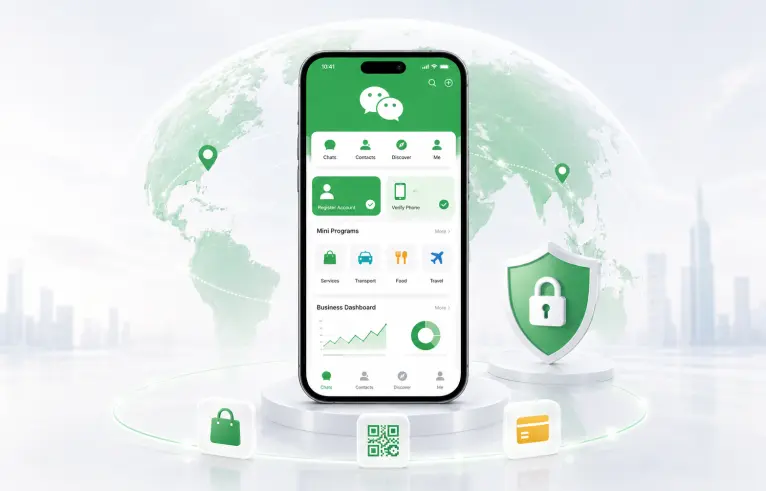

WeChat for International Users and Businesses: Registration, Verification, Mini Programs, and Privacy
WeChat is not just a messenger. For many international users and businesses, it is a complete digital ecosystem that combines messaging, calls, social networking, customer communication, payments, mini-programs, and business services inside one application.
This makes WeChat especially important for companies working with Chinese-speaking users, suppliers, partners, or customers. At the same time, WeChat comes with specific challenges: account registration may require phone verification, business accounts need proper setup, and mini-programs can create privacy and security risks if they are not developed and managed responsibly.
In this article, we explain how WeChat works for international users and businesses, why registration and verification may be complicated, and what companies should know about mini-program privacy, data access, AppSecret leaks, and user protection.
Why WeChat Matters for International Users and Businesses
WeChat is widely used for communication, commerce, customer support, content distribution, and online services. For users outside China, it can be a key tool for staying in touch with partners, suppliers, friends, communities, or business contacts connected to the Chinese market.
For businesses, WeChat can be used for:
- customer communication;
- brand presence;
- e-commerce;
- loyalty programs;
- online bookings;
- customer support;
- mini-program services;
- communication with suppliers and partners.
However, WeChat should not be treated like a simple chat app. A WeChat account may become a critical business asset. If access is lost, a company may lose customer conversations, supplier contacts, mini-program access, or important communication history.
That is why businesses should approach WeChat account registration, verification, and security as part of their digital infrastructure.
WeChat Registration for International Users
For international users, WeChat registration usually starts with a mobile phone number. The user selects a country or region, enters a phone number, receives a verification code, and completes the sign-up process.
In some cases, WeChat may require additional security checks. This can happen because of the user’s region, device, network, account behavior, or previous registration attempts. For business users, these checks can be inconvenient, especially when access to the registered phone number is lost or unavailable.
To reduce problems during WeChat registration, users should:
- use a stable phone number that will remain accessible;
- avoid using numbers that may be lost or quickly replaced;
- keep the same device and login environment when possible;
- avoid suspicious third-party tools;
- complete registration with accurate information;
- keep recovery options updated.
For businesses, it is especially risky to register important WeChat accounts using an employee’s personal phone number without internal documentation. If the employee leaves the company or loses access to the number, the business may lose control of the account.
WeChat Account Verification and Business Trust
Verification is an important part of WeChat’s account security and trust system. New accounts may face limits or additional checks if the platform detects unusual behavior, such as frequent device changes, abnormal login attempts, rapid contact additions, or mass messaging.
For professional use, a WeChat account should look consistent and trustworthy. This means using the account for a clear purpose, avoiding aggressive activity, and maintaining stable access details.
Businesses should also consider whether they need a personal WeChat account, a business presence, an official account, or a mini-program. A properly structured business presence can look more reliable to customers and partners than an unmanaged personal account.
A professional WeChat setup should include:
- clear account ownership;
- stable phone number access;
- secure login practices;
- internal access rules;
- backup contacts;
- documentation of who manages the account;
- regular checks of account security.
What Are WeChat Mini Programs?
WeChat mini-programs are lightweight applications that run inside WeChat. Users do not need to download a separate app from an app store. They can open a mini-program through a QR code, search, shared link, official account, or WeChat interface.
Mini-programs are used for many business purposes, including:
- online stores;
- food delivery;
- hotel and travel booking;
- loyalty programs;
- games;
- education;
- finance;
- healthcare;
- customer service;
- ticketing;
- local services.
For businesses, mini-programs are attractive because they reduce friction. A customer can open the service instantly inside WeChat, log in, place an order, make a payment, or contact support without installing a separate application.
However, mini-programs also create privacy and security responsibilities. They can request access to user data, location, phone numbers, payment-related information, and other sensitive details. If a mini-program is poorly developed, it may expose both users and the business to serious risks.
Privacy Risks in WeChat Mini Programs
Privacy is one of the most important issues in the WeChat mini-program ecosystem. Mini-programs may request access to personal data that is necessary for the service. For example, a delivery mini-program may need location access, and an e-commerce mini-program may need a phone number or shipping address.
The problem begins when a mini-program collects more data than it actually needs or when its privacy policy does not clearly explain what data is collected.
Research into WeChat mini-programs has shown several recurring privacy issues:
- some mini-programs collect more user data than they disclose;
- some do not provide clear privacy policies;
- some privacy policies do not match actual data collection behavior;
- some mini-programs request unnecessary permissions;
- some developers fail to explain how user data is stored and shared.
For users, this can mean sharing more information than expected. For businesses, this can create legal, reputational, and operational risks.
A business that launches a WeChat mini-program should follow the principle of data minimization: collect only the data that is necessary for the service. If a mini-program does not need precise location, full profile data, or additional identifiers, it should not request them.
AppSecret Leakage in WeChat Mini Programs
One of the most serious technical risks in WeChat mini-program development is AppSecret leakage.
An AppSecret is a sensitive credential used by a mini-program to authenticate with platform APIs. It should be stored securely on the server side. It should never be exposed in client-side code, public repositories, frontend files, or unsecured configuration files.
Studies of WeChat mini-programs have found that AppSecret leakage is a real and widespread issue. When an AppSecret is exposed, attackers may be able to abuse platform APIs, access sensitive functions, impersonate services, disrupt the mini-program, or steal data.
For a business, this is not only a technical mistake. It can become a security incident that affects customers, partners, and brand reputation.
To reduce AppSecret risks, businesses should:
- never hard-code AppSecrets in frontend code;
- keep sensitive credentials on the backend;
- restrict API permissions;
- rotate credentials when needed;
- monitor abnormal API usage;
- review code before release;
- avoid publishing secrets in Git repositories;
- use secure environment variables;
- conduct security testing before launch.
If a company uses an external agency or freelance developer, AppSecret protection should be included in the technical requirements from the beginning.
Excessive Data Collection: A Business and Compliance Problem
Excessive data collection happens when a mini-program collects more information than is necessary for its declared purpose. This may include phone numbers, location data, user identifiers, contact-related information, device data, or behavioral analytics.
For example, a simple content mini-program should usually not need precise location access. A discount coupon mini-program may not need detailed profile information. A basic customer support mini-program should not collect unnecessary behavioral data without a clear reason.
Excessive data collection creates several risks:
- users may lose trust in the brand;
- privacy policies may become inaccurate;
- regulators may question data practices;
- leaked data may create larger damage;
- partners may reject integration;
- the business may face reputational harm.
For international businesses, privacy expectations may vary by market. Users from different regions may have different legal protections and different levels of sensitivity around personal data. Therefore, businesses should design WeChat mini-programs with privacy by default.
Authentication and Login Risks in Mini Programs
Mini-programs often use login systems to connect WeChat users with business accounts, loyalty profiles, payment flows, or customer databases. If authentication is poorly implemented, attackers may be able to bypass login checks, impersonate users, or manipulate account data.
Common authentication risks include:
- trusting client-side user identifiers;
- using static or plaintext identifiers;
- failing to validate login sessions on the server;
- weak token management;
- insecure API endpoints;
- poor separation between frontend and backend logic;
- exposing sensitive login parameters.
Businesses should make sure that identity checks happen on the server side. A mini-program should not trust user data simply because it was sent from the client. Every sensitive request should be validated properly.
This is especially important for mini-programs connected to payments, loyalty points, customer profiles, personal information, or internal CRM systems.
WeChat Mini Programs and Data Permissions
Mini-programs may request different permissions depending on their function. These permissions may include access to user profile information, phone number, location, camera, storage, or other capabilities.
Before requesting any permission, a business should ask three questions:
- Is this permission truly necessary?
- Can the service work with less sensitive data?
- Is the request clearly explained to the user?
Unnecessary permission requests can reduce user trust and increase the chance of abandonment. If users do not understand why a mini-program needs access to certain data, they may refuse the permission or stop using the service.
A better approach is to request permissions only at the moment they are needed. For example, a mini-program should not ask for location access on the first screen if location is only needed later during delivery checkout.
Risks for Businesses Using WeChat Mini Programs
For businesses, WeChat mini-programs can be powerful, but they also create several types of risk.
Security Risk
If credentials, APIs, or authentication flows are poorly protected, attackers may abuse the mini-program or access sensitive data.
Privacy Risk
If the mini-program collects too much data or fails to explain its practices, the company may face user complaints or regulatory problems.
Reputational Risk
A data leak, suspicious permission request, or broken login flow can damage user trust.
Operational Risk
If account ownership, developer access, or backend credentials are not properly managed, the business may lose control over the mini-program.
Compliance Risk
International companies may need to consider privacy expectations and legal requirements in different regions.
To manage these risks, businesses should treat mini-program development as a serious software and security project, not just as a marketing experiment.
Best Practices for Businesses Launching a WeChat Mini Program
Before launching a WeChat mini-program, businesses should create a clear security and privacy checklist.
Recommended best practices include:
- define the exact purpose of the mini-program;
- collect only necessary user data;
- write a privacy policy that matches actual data behavior;
- store AppSecrets and API keys securely;
- validate user identity on the server side;
- avoid hard-coded credentials;
- review third-party SDKs;
- limit employee and contractor access;
- monitor API activity;
- test login and payment flows;
- document data retention rules;
- prepare an incident-response plan;
- update the mini-program regularly.
Businesses should also review whether every requested permission is justified. If the mini-program does not need location, camera, or phone number access, those permissions should not be requested.
Practical Tips for International Users
International users can also reduce risks when using WeChat and WeChat mini-programs.
Useful safety tips include:
- register with a stable phone number;
- avoid losing access to the registered number;
- keep the app updated;
- be careful with unknown QR codes;
- check what permissions a mini-program requests;
- avoid sharing sensitive information with unknown mini-programs;
- use official channels when possible;
- be cautious with payment requests;
- do not install suspicious third-party tools;
- monitor account activity.
If a mini-program requests data that seems unnecessary for its function, it is safer to deny the permission or avoid using the service.
Conclusion
WeChat is a powerful tool for international users and businesses, but it requires careful account management and responsible data handling. Registration and verification depend heavily on phone number access, so users and companies should use stable, secure, and well-documented account details.
For businesses, WeChat mini-programs offer strong opportunities in e-commerce, customer service, loyalty programs, and digital services. However, they also introduce privacy and security risks. Research has shown that some mini-programs suffer from AppSecret leakage, excessive data collection, unclear privacy policies, and weak authentication practices.
The safest approach is to treat WeChat as professional digital infrastructure. Businesses should protect account access, minimize data collection, secure credentials, validate authentication on the backend, and make privacy practices transparent. Users should be careful with permissions, unknown mini-programs, and account recovery settings.
When used responsibly, WeChat can be an effective platform for international communication and business growth. But trust depends on security, privacy, and responsible account management.
FAQ
Is WeChat difficult to register for international users?
WeChat registration can be more complicated for international users because it usually requires a mobile phone number, verification code, and sometimes additional security checks. Using a stable phone number and consistent device can help reduce registration problems.
Can businesses use WeChat for customer communication?
Yes, businesses can use WeChat for customer communication, support, e-commerce, loyalty programs, and partner communication. However, business accounts should be managed carefully, with clear ownership, secure access, and backup procedures.
What are WeChat mini-programs?
WeChat mini-programs are lightweight applications that run inside WeChat. Users can open them without installing a separate app. They are commonly used for shopping, booking, customer service, payments, games, and loyalty programs.
Are WeChat mini-programs safe?
Many WeChat mini-programs are legitimate and useful, but safety depends on how they are developed and managed. Poorly developed mini-programs may request excessive permissions, collect unnecessary data, or expose sensitive credentials.
What is AppSecret leakage in WeChat mini-programs?
AppSecret leakage happens when a sensitive mini-program credential is exposed in client-side code, public files, or insecure storage. This can allow attackers to abuse APIs, access sensitive functions, or damage the business.
Why is excessive data collection a problem?
Excessive data collection means a mini-program collects more information than it needs. This can reduce user trust, increase compliance risks, and make any future data leak more damaging.
How can businesses protect WeChat mini-program users?
Businesses can protect users by collecting only necessary data, securing AppSecrets, using server-side authentication, writing accurate privacy policies, limiting employee access, and regularly reviewing mini-program security.
Should users grant all permissions requested by a mini-program?
No. Users should grant permissions only when they understand why the mini-program needs them. If a simple service requests unnecessary access to location, profile data, or phone number, users should be cautious.