










Tone of Voice: Effective Brand Communication with the Audience
Launching a new brand into the market is always a stressful task for a company responsible for the new product. Numerous details need to be taken into account and carefully thought out, from branding and slogans to positioning. This is where tone of voice comes in (translated from English as "the tone of voice") – the foundation of any public enterprise's communication strategy. Today, let's try to understand what it is and how to use it.
Tone of Voice: What It Means in Marketing?

The term "tone of voice" refers to a brand's way of communicating and expressing itself. It encompasses the principles of interacting with the audience that help the brand stand out and differentiate itself from competitors. The brand's voice should reflect its unique qualities and product values. This includes language choice - formal or informal, communication tone - cheerful or serious, bold or respectful. It also involves selecting terms and words that can or cannot be used in messages. The brand's tone manifests in the following aspects:
- information on the official website;
- posts on social media;
- interaction between customers and personnel online or offline;
- correspondence with customers in personal brand account messages or comments.
Developed tone of voice in social media management becomes an integral part of the corporate culture shared by all employees and conveyed in various areas, ranging from Instagram texts to cashier greetings behind the counter.
Company's Tone of Voice: Functions

The functions of a brand's tone of voice include the following positions:
- Building brand recognition: this helps consumers trust products from well-known brands more quickly. Even if a person has no prior experience with the brand, they already have positive perceptions of the company and its products;
- Expressing values: it is essential not only to talk about values but also to demonstrate them in practice. For example, if a brand values customer care, it should be reflected in the way employees interact with customers and the services they provide;
- Establishing an emotional connection: the brand should trigger an emotional response from consumers. The main goal is to create strong positive emotions associated with the brand and its products.
To get closer to the target audience and find out what truly interests customers, speech analytics can be used. It helps recognize words, classify inquiries, and show which department the customer contacted and what service they requested. This allows not only to control the cost and quantity of leads but also to improve their progress through the sales funnel.
Types of Tone of Voice
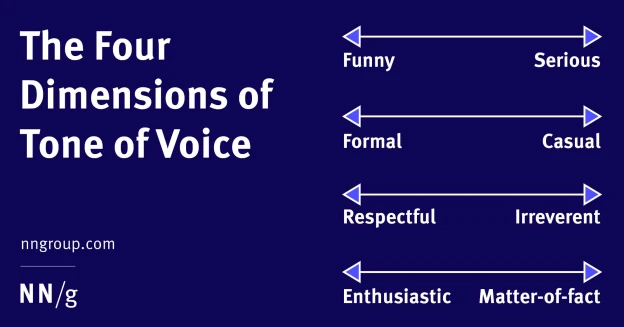
The brand voice can vary depending on the goals of the company. For example, it can be entertaining if the goal is to entertain customers, or sales-oriented if the goal is to promote products based on their advantages.
The main types of tone of voice include: positive, respectful, comedic, dry, conversational, cheerful, sarcastic, uncompromising, sympathetic, provocative, friendly, conservative, nitpicking, playful, candid, rude, inspiring, official, nostalgic, serious, romantic, business-like, enthusiastic, caring, authoritative, blunt, informational, and confidential.
Tone of Voice: Friendly Brand

Companies of this type often have a "people's" brand image, and their characteristics include:
- Using "you" and addressing customers as "friends";
- Revealing internal aspects of the company and secret information;
- Posts that are devoid of dry facts, statistics, and pretentiousness;
- Honesty when discussing failures;
- Highlighting the love for work through the eyes of others;
- Announcing small achievements.
Striking a balance between friendly tone of voice and professional communication can be challenging. If a friendly style is chosen, it is important to maintain a boundary of authority to avoid the perception of the brand as purely a commercial project.
Tone of Voice: Provocative Brand
These companies aim to attract attention by acting provocatively and not being afraid to violate social norms and ethics. The main characteristics include:
- Using dramatic events for PR;
- Grabbing attention with sensational headlines;
- Bold communication tone;
- Initiating discussions on controversial and current topics to stimulate engagement.
This approach can be used by both local and global brands, newcomers to the market, and longstanding participants. When using this strategy, it is important to clearly define boundaries in order to avoid offending customers and damaging the brand's reputation.
Tone of Voice: Utility Brand

The main feature of these companies is their expertise in a chosen field. Their materials contain useful information, statistics, and facts. Brands showcase themselves in the following ways:
- Interacting with the audience and answering questions;
- Providing information about their experience and offering online consultations;
- Publishing materials on complex topics and providing advice and life hacks.
Here's another example of a tone of voice: When choosing this strategy, it is important to be able to explain complex concepts using simple and understandable language. Expertise should serve the purpose of helping customers understand the problem rather than confusing them with technical terms.
Tone of voice: an entertaining brand

Companies that employ this strategy focus on creating entertaining content to attract attention and stand out among competitors. Such brands:
- Develop interactive content such as quizzes, tests, trivia, and live streams;
- Curate funny or engaging facts about their products;
- Present current topics in a humorous way;
- Publicize unusual news.
When choosing an unconventional approach to attract an audience, it is important to determine the archetypes of Tone of voice. Continuously monitor customer comments and reactions to avoid creating content that may annoy rather than delight.
How to establish Tone of voice?

The process of determining the right brand communication style goes through several stages. It is important to carefully analyze the information at each stage to form a comprehensive understanding of the company's style.
Crafting the brand's story

At this stage, it is necessary to analyze how you want to present yourself to the audience and how you want to be perceived. This includes:
- The purpose of your company and its entry into the market;
- The information you want to convey to your customers;
- Expectations for how your brand will be perceived;
- Emotions and feelings you want to evoke in people when interacting with your brand.
Examples of a brand's Tone of voice show that personalizing your company will help define its communication style. For a building supply store, for example, the following attributes are characteristic: average age, blue-collar professions, average income level. This audience is knowledgeable about construction materials and is always ready to help, offering advice and budget-friendly products. They prefer a friendly communication style.
Getting to know the audience

Understanding your target audience is a fundamental part of running a business. You should have information about the age, gender, interests, and income of your customers. Analytical services, such as Google Analytics, can help gather this information. It is also useful to study your customers' social media profiles to understand how they interact with each other and what they discuss.
Determining brand values

Defining values not only helps determine the communication style but also attracts loyal supporters. To determine your company's values, ask yourself the following questions:
- Why is your company's product unique?
- What benefit do customers gain from using your brand's products?
- What messages and attitudes are you conveying to your audience?
- Which values resonate with your customers?
These steps will not only help define how to create a Tone of voice but also enable a deeper connection with your audience.
Development of Tone of Voice and Communication Channels

At this stage, it is necessary to integrate the acquired information to determine the tone of voice of your brand. Company representatives determine where and how communication with the audience will take place, including the use of social media, advertising campaigns, and email newsletters. For the year 2023, the following statistics are available for possible communication channels using the brand's tone of voice:
- Generation X, born before 1984, tend to view advertisements, be interested in news, and primarily use Facebook (owned by Meta, recognized as an extremist organization in Russia).
- Generation Y or Millennials, born after 1984, tend to view electronic newsletters, use Instagram, and Facebook (owned by Meta, recognized as an extremist organization in Russia).
- Generation Z or Centennials, born after 2000, actively use Instagram (owned by Meta, recognized as an extremist organization in Russia) and TikTok.
Implementing Tone of Voice
In order for company employees to understand how to communicate on behalf of the brand, it is recommended to prepare an instruction manual. This instruction manual should include the following elements:
- Brand values.
- Target audience profile.
- Brand persona - what the company would be like if it were a person.
- Communication style boundaries - what is acceptable in social media responses, phone calls, and in-person communication.
- Allowed and prohibited words.
- Message composition peculiarities - the use of emojis, exclamation marks, sentence length.
All of the above directly influences the types of Tone of Voice used. Tracking the quality of customer communication and analyzing it can be done using call tracking. This tool records calls and provides reports by day and hour. Listening to call recordings helps analyze the work of managers and improve their communication skills. Additionally, call tracking can determine the advertising sources from which calls are coming. These data will help you understand which advertising platforms bring in more customers and optimize your advertising campaign budget.
Tone of voice: examples of common mistakes

Companies sometimes make mistakes when choosing their brand's tone of voice. These mistakes can include ignoring the audience's characteristics, lacking clear boundaries in communication style, or not aligning with the chosen strategy. The consequences of these mistakes can result in alienating the audience, losing trust, and damaging the reputation:
- Imitating the tone of voice of other brands. Copying another brand's communication strategy is considered unethical. If you start using a communication style similar to a well-known company in your industry, it will inevitably draw attention from customers. They will lose trust in you and may prefer a brand with a unique voice.
- Using identical responses. It is important to remember that communication with the audience should be contextual. If you have chosen an entertaining communication style, it does not mean that every message should be humorous. The tone of voice serves as the foundation for communication but should not be a rigid template.
- Abrupt change in the brand's tone of voice. Company values can change over time, and with them, the brand's voice may change too. However, it is important for the core style to remain consistent, and any changes should be introduced gradually and carefully.
- Unnaturalness. Imitating the brand's voice can come across as unnatural and create negative feelings, as customers can sense the insincerity and stop trusting the company.
- Aggressiveness. Aggressive communication, especially in response to negative feedback, can harm the brand's reputation. Even if your brand follows a provocative communication style, it is important to maintain a respectful attitude towards the audience.
Instead of conclusion,
Before choosing your brand's voice, define the values you want to convey to your audience. Analyze the characteristics of your target audience, such as interests, average age, and income levels. Choose a communication style that best aligns with these characteristics and create guidelines for employees on using the brand's voice. The tone of voice can be adjusted depending on the situation, but its foundation should remain constant in order to maintain audience loyalty and interest.